Autonomous Vehicles
How abstraction enables engineering
Contents
Tip: Use the toggle at top-right to switch between slide view and article mode.
Clubs at U-M for autonomy
- Michigan Autonomous Aerial Vehicles (MAAV) — autonomous drones and perception. Site: maavumich.org
- Michigan Mars Rover (MRover) — autonomous rover: perception, planning, manipulation. Site: mrover.org
- UM::Autonomy — RoboBoat autonomous surface vehicle. Site: umautonomy.com
- Michigan Robotic Submarine (Robosub) — underwater autonomy and perception. Site: www.michiganrobosub.com
Tip: These teams welcome newcomers; all majors are encouraged. Look for software (perception, SLAM, planning), embedded systems, and controls roles.
What is autonomy (discussion)
SAE levels of driving automation (J3016)
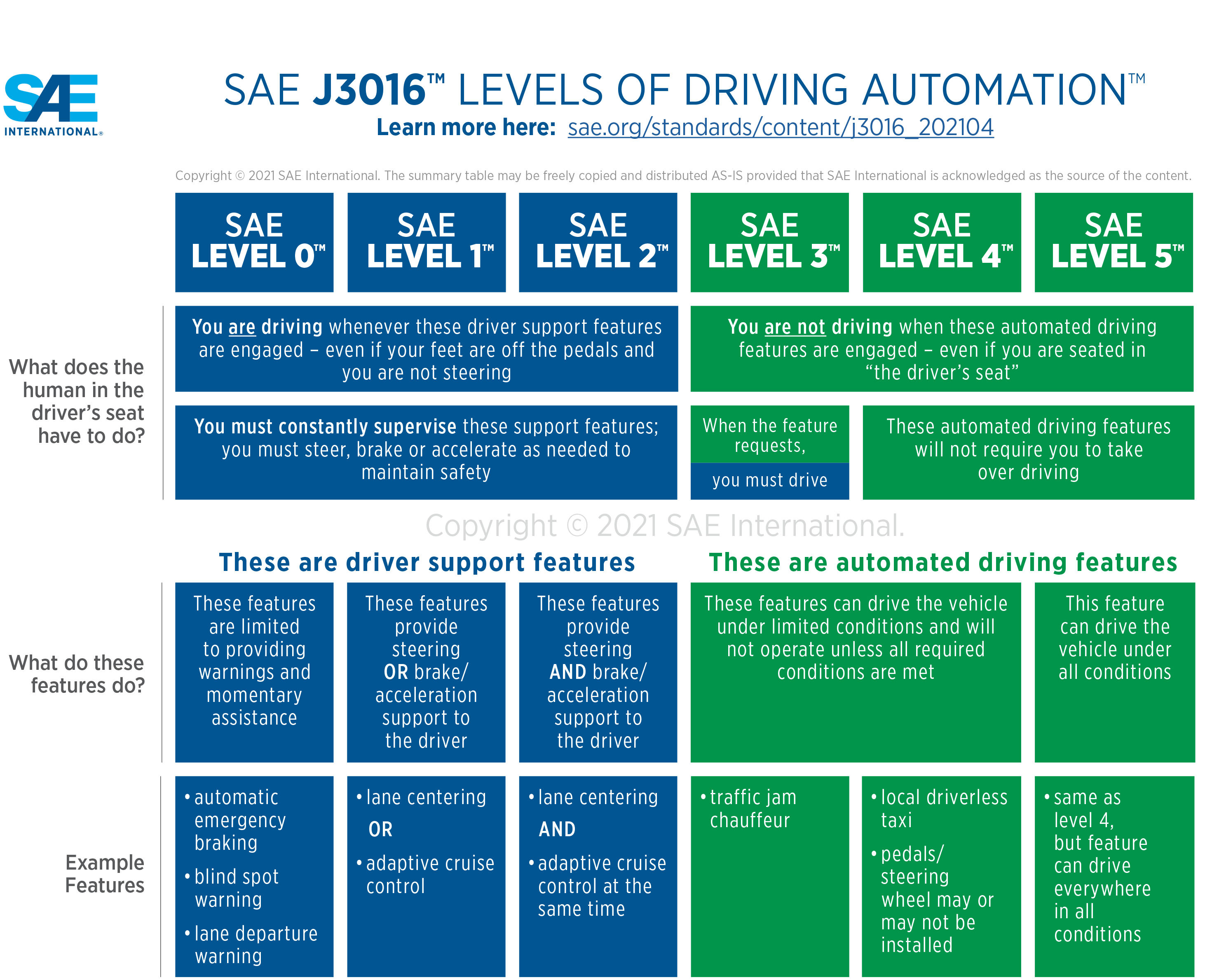
Graphic: SAE J3016 levels of driving automation. See the SAE blog update for details and definitions: sae.org/blog/sae-j3016-update.
Abstraction: from physics to decisions
- Electromagnetics & mechanics (photons, forces)
- Transducers & signals (voltages, point clouds)
- Features & objects (lanes, vehicles, pedestrians)
- Scene understanding (semantics, intentions)
- Prediction & planning (what, when, where)
- Control & actuation (torque, brake pressure)
Each layer hides complexity and exposes interfaces that software can reason about. Classic references: NVIDIA DRIVE, Waymo Research.
The AV software stack
- Sensing: cameras, lidar, radar, IMU, GPS
- Perception: detection, segmentation, tracking
- Localization & mapping: SLAM, HD maps
- Prediction: motion forecasting
- Planning: behavior + trajectory generation
- Control: MPC / PID tracking
- Compute: accelerators, safety, redundancy
Overviews: Mobileye: the self‑driving stack, NVIDIA DRIVE SDK.
Autonomous driving in extreme weather
Video: Autonomous vehicles in extreme weather. Consider sensor robustness: cameras vs. lidar vs. radar in rain/fog/snow.
Interactive room: click to sample distance and update estimate
Click inside the room to sample a wall distance and update a running estimate. Measurement model: \(z_t = d + \varepsilon,\; \varepsilon \sim \mathcal{N}(0, \sigma^2)\). We smooth noisy readings with an exponential moving average (EMA): \(x_t = (1-\alpha)\,x_{t-1} + \alpha\,z_t\). Smaller \(\alpha\) smooths; larger \(\alpha\) reacts faster.
Major players and approaches
Tesla AI days (vision stack): tesla.com/AI. Waymo tech: Waymo Engineering Blog.
Latest tech

- Emerging approaches leverage modern networks and compute.
- Accelerators enable real‑time perception and planning.
- Connectivity and data pipelines drive model improvements.
Autonomous simulation
Open research and simulation tools for autonomous driving.
Reasoning about complex scenes
Perception abstracts millions of pixels into objects, lanes, and free space. Prediction abstracts motion into probabilistic trajectories. Planning reduces choices to feasible, safe maneuvers.
Image: Shibuya Crossing (2018). Background complexity motivates layered abstractions. Read about Shibuya Crossing.
Behavior abstraction as a finite‑state machine
- Engineers abstract continuous complexity into discrete modes (states).
- Transitions encode policy and safety constraints.
- Works with planners (e.g., trajectory optimizer) downstream.
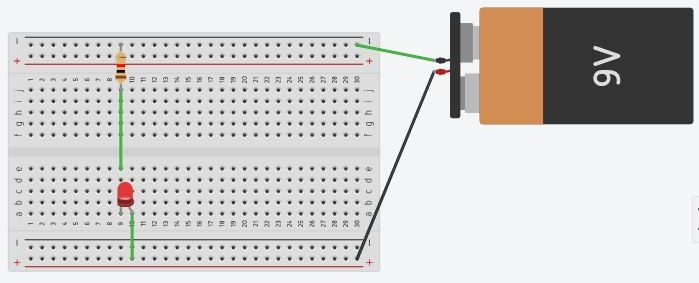
EE abstraction: RC circuit — physics, math, and model
From abstraction to automation
- Define interfaces between layers (contracts).
- Choose representations that simplify reasoning.
- Quantify uncertainty and safety (RSS, verification).
- Automate with data, simulation, and closed‑loop testing.
Further reading: A Survey of Motion Planning and Control Techniques for Self-driving Urban Vehicles.
Where things break down: why AV failures occur
- Sensor degradation: glare, low light, rain/fog; occlusions and dirty lenses.
- Perception ambiguity: unusual objects, adversarial appearances, poor calibration.
- Prediction edge cases: rare human behaviors, multi-agent interactions, distribution shift.
- Planning/control limits: poor cost tuning, unmodeled dynamics, actuation saturation.
- System/UX: handoff timing, alerts ignored, map inaccuracies, software bugs.
- Long-tail risk: rare combinations not seen in training or testing.
Use layered safety: sensing redundancy, robust perception, conservative planning, fallback maneuvers, and rigorous testing.
Case study: Waymo recall
Video: Waymo recall. Discuss root causes, corrective actions, and implications for safety cases and validation.
Credits and links
- Reveal.js: https://revealjs.com
- Mobileye Self‑Driving Stack: blog
- Waymo Engineering Blog: blog.waymo.com
- Torc Robotics: torc.ai
- Tesla AI: tesla.com/AI
- NVIDIA DRIVE: developer.nvidia.com/drive