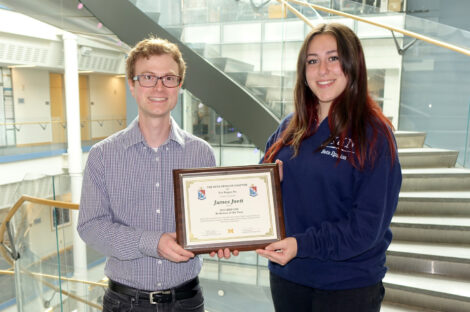
Jessy Grizzle
Stephen S. Attwood Award
|
Jessy Grizzle, Jerry W. and Carol L. Levin Professor
Engineering, is internationally recognized for his theoretical work
on nonlinear control systems. He is performing path-breaking
research in the feedback control of bipedal locomotion in machines
using the robot MABEL; he is working with engineers at Ford Motor
Company to reduce emissions and enhance fuel economy in HEVs; he
invented a broadband RF sensor for use in plasma processing systems;
and he is involved in a project to improve the regulation of blood
glucose levels in ICU patients. Prof. Grizzle is devoted to his
students, earning him a CoE Teaching Award, and a student-elected
Engineering Professor of the Year award. He is co-author of the
book, Feedback Control of Dynamic Bipedal Robot Locomotion.
The Stephen S. Attwood Award is the highest faculty achievement
award conferred by the College. |

Amir Mortazawi
Service Excellence
Award |
Amir Mortazawi has delivered exceptional service to
his profession and to the ECE Division, especially as Chair of the
EE Graduate Committee, as an undergraduate instructor, and as a
graduate mentor. As EE graduate committee chair, he was committed to
attracting top quality students, and during a five-year period under
his leadership, saw
the GPA of incoming graduate students rise significantly. Alumni
still appreciate his helpfulness as graduate advisor for the applied electromagnetics and RF area. In addition to
other significant
service in the professional community, he serves as Editor-in-Chief
of the major journal in his field, Transactions on Microwave
Theory and Techniques. |

Greg Wakefield
Service Excellence
Award |
Greg Wakefield has shown remarkable leadership in
two major service activities within the EECS Department. As Chair of
the EECS Curriculum Committee, he established an efficient committee
structure for all of the degree programs within the department
during an important time of internal departmental restructuring. He
also oversaw the most recent successful ABET accreditation process
for all four degree programs. Greg has been praised for his valuable
contributions to a wide variety of service activities, including the
Arts of Earth activities, the CoE International Programs Committee,
and the Faculty Grants and Awards Program with OVPR. |

David Chesney
Thomas M. Sawyer, Jr.
Teaching Award |
Dave Chesney has made significant and lasting
contributions to teaching, curriculum development and outreach since
joining U-M in 2001. In addition to his contributions as an engaging
teacher in a variety of courses, his interest in social issues and
broad approach to computing led him to develop or co-develop the
courses: Gaming for the Greater Good, Multi-Disciplinary
Engineering, and Ethics and Information Technology. Dave leads the
departmental efforts in K-12 outreach in the area of computing, and
focuses on developing new software to enhance the students' learning
experience. He is a published author on teaching techniques, and he
has addressed the U.S. Dept. of Education as a panelist. |
|
Professors Michael Flynn, Yogesh Gianchandani,
Khalil Najafi, Dennis Sylvester, Ken Wise, and Ted Zellers were key
contributors to establishing the University of Michigan as a
world-renowned research center in the area of microelectromechancial
systems and integrated microsystems. The research efforts have
focused on two testbed microsystems. The first is a family of
implantable neural prostheses for disorders such as deafness,
paralysis, epilepsy, and Parkinson's disease, and the second is a
wristwatch-size environmental monitor for pressure, temperature,
humidity, radiation-level, and air quality.
Michael Flynn has demonstrated new
energy-efficient, flexible and capable interface circuits that
connect to the neural prosthesis and environmental monitoring
testbeds. He led efforts to develop the Wireless Integrated Sensing
Platform system.
Yogesh Gianchandani has done pioneering work
on micro-electro-discharge machining, which supplies high voltage to
the environmental testbed, and which has been used to form smart
stents. His work with microplasmas was used to realize a microGeiger
counter for radiation detection.
Khalil Najafi, Schlumberger Professor of
Engineering, made major contributions in
hermetic and vacuum packaging for inertial sensors, infrared
sensors, and radio-frequency resonators used in wireless interfaces.
His work in wafer bonding processes for biomedical devices has led
to the technology being transferred to the start-up company, ePak.
Dennis Sylvester developed the ultra low
power Phoenix processor, which can be used with the intraocular
pressure sensors developed by Prof. Wise for glaucoma treatment. The
processor runs at low standby power (30pW), making it suitable for
other power-critical applications.
Ken Wise, William Gould Dow Distinguished
University Professor, is the team leader and Director of
the NSF ERC for Integrated Wireless MicroSystems (WIMS). His own
research includes cochlear implants for the deaf, neural interfaces
for presthetic and neuroscience applications, intraocular pressure
monitoring for glaucoma diagnosis, and gas analysis systems based on
chromatography.
Ted Zellers, from the School of Public
Health, was instrumental in the development of the gas
chromatograph, overseeing everything from system architecture to
component integration and testing. He demonstrated the detection of
biomarkers for tuberculosis and lung cancer.
|