
 MENU
MENU 

Soil moisture study aims for climate change insights
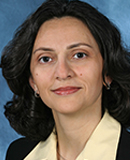
Moghaddam will oversee the design and fabrication of the AirMOSS instrument, a high-powered, low-frequency radar that NASA/JPL collaborators will build for the project.
 Enlarge
A new $26-million NASA project led by a University of Michigan researcher aims to help clarify how ecosystems exchange carbon with the atmosphere, an important piece of missing knowledge in the quest to understand, predict, and adapt to climate change.
The project’s goal is to provide crucial missing information that will help determine whether the North American continent is a net source or sink of carbon. Researchers from U-M, NASA’s Jet Propulsion Laboratory, Harvard University, MIT, Oregon State University, NASA’s Goddard Space Flight Center, the U.S. Department of Agriculture, and Purdue University are taking part.
 Enlarge
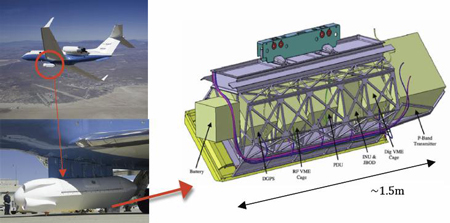
Over the next five years, a radar instrument called the Airborne Microwave Observatory of Subcanopy and Subsurface (AirMOSS) will collect data in nine North American regions from aboard a Gulfstream-III aircraft. The radar data will be converted to measurements of soil moisture by using sophisticated computer simulations. The radar, to be built during the first year-and-a-half of the project, generates signals that can penetrate up to four feet beneath the ground surface. This state-of-the-art low-frequency radar will be the most compact and versatile radar of its kind built to-date, says principal investigator Mahta Moghaddam, a professor in the Department of Electrical Engineering and Computer Science.
Root-zone soil moisture levels directly affect how well a plant is functioning.
“Even your houseplant has its own net exchange of carbon,” Moghaddam said. “It takes carbon dioxide in during the day through photosynthesis, provided there is sunlight and it’s warm enough. And breathes out some carbon dioxide at night. How much net carbon it sequesters, and therefore how much the plant grows, has to do with how much water is available to its roots: No water, no growth.”
Scientists don’t understand exactly when and where this net carbon exchange process is most efficient, or how much the net exchange differs across ecosystems. They might know it for a few selected locations across North America where they have manually sampled, but not on the large scale that AirMOSS will enable. Lack of current knowledge about root zone soil moisture is believed to contribute 60-80 percent of the uncertainty about how much the ecosystems exchange carbon with the atmosphere.
Collaborating researchers will incorporate Moghaddam’s root zone soil moisture measurements into hydrology and ecosystem models to produce a continental estimate of the net ecosystem exchange. The results, which will show whether the continent takes in or releases more carbon and by how much, are expected by May 2015.
Moghaddam will oversee the design and fabrication of the AirMOSS instrument, a table-top-sized, high-powered, low-frequency radar that NASA/JPL collaborators will build for the project. She has also developed computational techniques to analyze the signals it sends back. Moghaddam’s research group is a leader in developing radar algorithms for subsurface characterization.
“This work will help us understand a piece of the carbon cycle puzzle,” Moghaddam said. “We may know that different areas in north America act as sinks or sources of carbon, but we don’t know how large the net carbon exchange is, how fast it’s changing, or how big it’s going to get. Today, we rely on model estimates and there is huge uncertainty.”
Beyond this project, Moghaddam envisions other applications for this radar instrument, including surveillance and resource exploration.